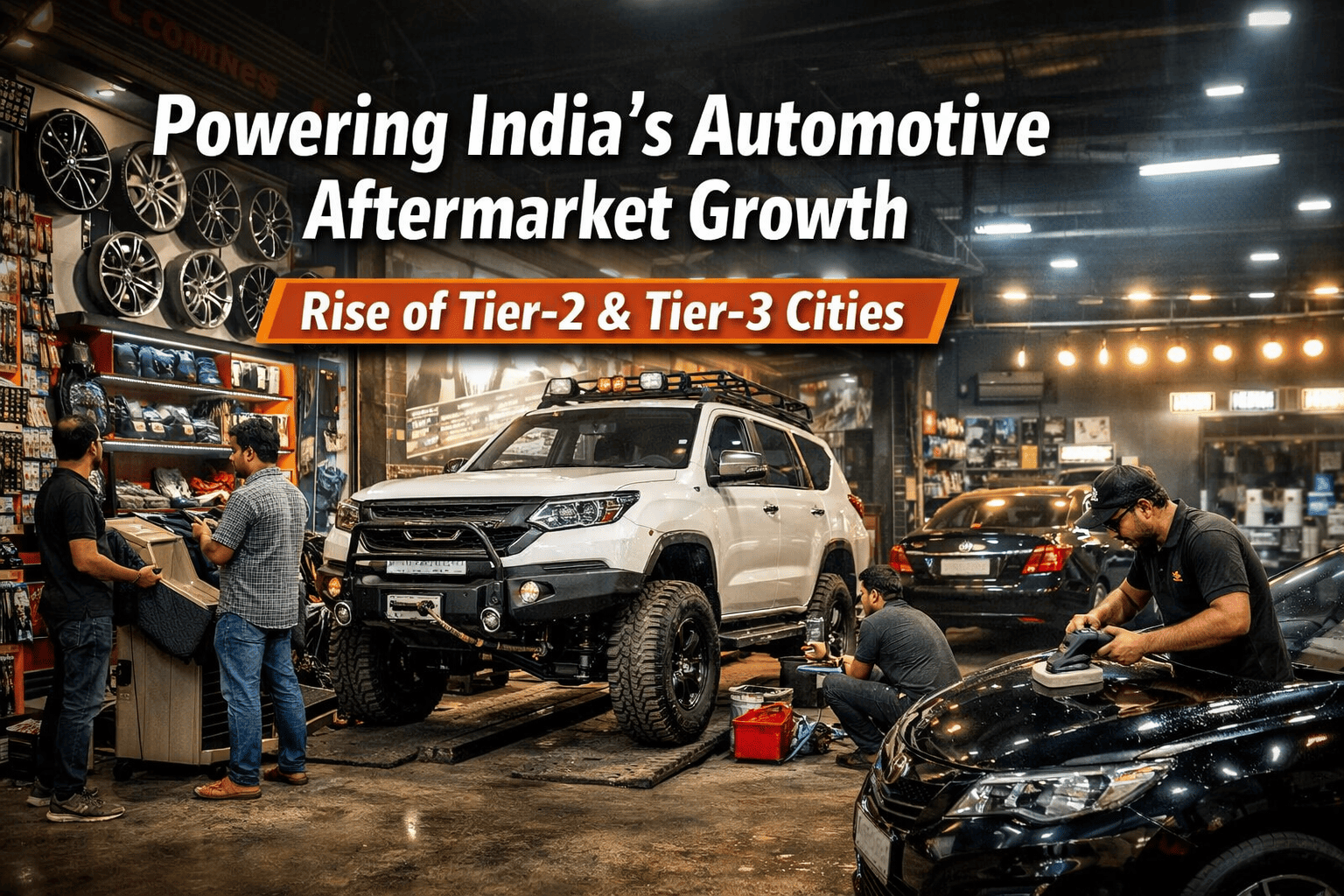
Why Tier-2 & Tier-3 Cities Are Powering India’s Automotive Aftermarket
For years, India’s automotive aftermarket growth has focused heavily on metros—Delhi NCR, Mumbai, Bengaluru, Chennai, and Hyderabad. These cities have always been the hotspots for premium car ownership, customisation trends, detailing culture, and performance upgrades.That’s Why Tier-2 & Tier-3 Cities Are Powering India’s Automotive Aftermarket
But the industry is now experiencing a major shift.
Tier-2 and Tier-3 cities have quietly—and rapidly—emerged as the next big growth engine. From thriving accessory markets to booming detailing studios and rising demand for performance parts, these cities are reshaping the aftermarket landscape faster than ever before.
For aftermarket brands, manufacturers, installers, distributors, workshops, and retailers, this shift represents a massive opportunity waiting to be tapped.
Rising Vehicle Ownership Is Creating a Larger Customer Base
The first major driver of growth is the dramatic increase in vehicle ownership across non-metro cities.
Cities like Surat, Coimbatore, Indore, Nagpur, Kochi, Lucknow, Jaipur, Guwahati, Bhubaneswar, Ludhiana, Vizag, and Vadodara are witnessing rising sales across cars, two-wheelers, SUVs, and even premium imported models.
What makes this even more promising?
Tier-2 & Tier-3 consumers are aspirational buyers
They’re not buying vehicles only for basic transport—they want comfort, safety, and style. This directly fuels demand for:
- Accessories
- Seat covers & interiors
- Infotainment upgrades
- Styling kits
- Car care products
- Detailing services
- Performance enhancements
SUV penetration is skyrocketing
The growth of SUVs like Creta, Fortuner, Thar, Jimny, Seltos, and XUV700 is especially strong in non-metros.
And more SUVs = more spending on:
- Off-road accessories
- Lighting upgrades
- Tyres & suspension
- Roof racks
- Exterior styling
For aftermarket brands looking for real market expansion, Tier-2 and Tier-3 cities offer a base that’s becoming larger—and more willing to spend—than ever before.
The Pre-Owned Market Is Exploding — and So Is Upgrading
Non-metro India is experiencing a surge in pre-owned car buying.
With more organised dealerships entering smaller cities, customers now get:
- Certified vehicles
- Financing options
- Warranty packages
- Quality assurance
And what does a pre-owned car owner do first?
They upgrade it.
Aesthetic upgrades, essential accessories, infotainment systems, tyres, and even performance parts become priority investments.
This creates a powerful aftermarket cycle:
More pre-owned cars → More upgrades → More demand for accessories, detailing, tools & services
For exhibitors and aftermarket brands, this means opportunity at scale—because Tier-2 and Tier-3 cities are no longer just adopting pre-owned vehicles; they’re embracing aftermarket upgrades with equal enthusiasm.
Detailing Studios Are Booming Beyond Metros
The detailing industry has made one of the strongest shifts into smaller cities.
In the last 3–5 years:
- Local entrepreneurs
- Returning professionals
- Passionate enthusiasts
…have all invested in high-end detailing studios.
Ceramic coating, PPF, interior restoration, polishing, foam washing, and premium car care services are no longer metro-exclusive offerings.
Why the boom?
- More disposable income
- Growing awareness of vehicle maintenance
- Rising pride of ownership
- Smaller cities offering larger spaces for workshops
- Social media influencing consumer choices
For brands selling coatings, tools, machines, consumables, air solutions, and garage equipment—these markets aren’t just promising; they’re growing aggressively.
Accessory Markets Are Becoming More Organised
A major shift happening across Tier-2 and Tier-3 markets is the rise of organised, professional accessory stores.
Unlike earlier years where businesses were small, scattered, and informal, we now see:
- Multi-brand accessory showrooms
- Dedicated installation bays
- Modern store layouts
- Qualified installers
- Workshop-level professionalism
And these stores don’t just sell seat covers anymore—they sell:
- Ambient lighting
- Touchscreen infotainment systems
- Subwoofers & DSPs
- Exhaust systems
- Suspension kits
- Dashcams
- Reverse cameras & sensors
- PPF & wraps
This means exhibitors and brands have access to a new category of serious B2B buyers—retailers who are upgrading fast and stocking premium products.
Performance Culture Is Growing Faster Than Expected
Performance, tuning, and modification culture has now entered smaller cities in a big way.
Not long ago, remaps, exhaust upgrades, intakes, or suspension kits were mostly a metro trend. But today:
- Jamshedpur has enthusiasts modifying their SUVs
- Surat has a booming tuning scene
- Coimbatore is a performance parts hub
- Ludhiana and Chandigarh have thriving custom garages
- Kochi is a hotspot for audio and tuning together
What’s driving this?
- More young buyers
- Easier access to information
- YouTube and Instagram influence
- OEM warranty awareness growing
- Availability of financing options
- Workshops investing in new equipment
For exhibitors offering performance parts, tuning tools, diagnostic systems, turbos, exhausts, intakes, and suspension products—these cities represent untapped gold.
E-commerce Popularity Is Fueling Offline Demand
Online platforms have educated customers in Tier-2 and Tier-3 cities about:
- New accessories
- Global tech trends
- Styling upgrades
- Car care essentials
- Audio enhancements
But most still prefer offline installation, creating strong business for:
- Accessory shops
- Workshops
- Detailers
- Retailers
E-commerce awareness paired with offline demand is creating a dual engine of growth—making smaller cities highly profitable for aftermarket businesses.
Workshops and Installers Are Upgrading Their Capabilities
Workshops in non-metro cities are no longer just service centers—they are becoming:
- Tech-driven
- Professionally managed
- Better equipped
- Skilled in electrical and mechanical installations
- Open to partnerships with brands
This upgrade is driven by:
- Rising customer expectations
- Training videos and online learning
- Better access to tools
- More revenue potential through add-on services
For exhibitors, this means a stronger, more capable network of B2B partners outside metros—ready to stock products, learn new technologies, and deliver installations confidently.
Lower Competition, Higher Loyalty
One of the biggest advantages in Tier-2 & Tier-3 cities is brand loyalty.
While metros are saturated and competitive, smaller cities offer:
- Lower competition
- Higher word-of-mouth impact
- Long-term customer relationships
- Repeat business
- Better market penetration
A single strong distributor or retailer in a Tier-2 market can build more sustained sales than 10 small retailers in metros.
Influencer & Enthusiast Communities Are Growing Rapidly
Car meets, audio gatherings, off-roading groups, biking communities, and local automotive clubs are now active across smaller cities.
These communities:
- Create demand for modifications
- Influence buying decisions
- Support local installers
- Build interest in performance and styling
For aftermarket brands, this is a powerful grassroots marketing ecosystem.
The Real Industry Growth Will Come From Smaller Cities
Here’s the big picture:
Metros will always matter—but their markets are maturing.
The next wave of growth will come from the cities that are:
- Expanding fast
- Hungry for upgrades
- Less saturated
- More open to new brands
- Rich with young, aspirational buyers
- Evolving into automotive hubs
For exhibitors, this shift is critical.
These cities aren’t just “potential”—they are active, growing, high-value markets waiting for the right brands, the right products, and the right partnerships.
Final Thoughts: The Smartest Expansion Strategy Today
The real opportunity for aftermarket brands today lies in understanding this simple reality:
Tier-2 and Tier-3 cities aren’t the future—they are the present.
Whether you deal in accessories, performance parts, detailing products, tools, audio tech, or workshop equipment, these markets offer:
- Higher conversion
- Lower competition
- Faster adoption
- Stronger loyalty
- More sustainable growth
Brands that enter early will establish dominance. Brands that wait will enter a crowded space later. The shift is already happening. The question is whether you will move with it, or after it.